

 English
 Español
Content
- 1 Motor Housing Failure Analysis: A Root-Cause Framework
- 2 Motor Housing Failure Modes: What the Evidence Shows
- 3 Mechanical Root Causes Behind Motor Housing Failure
- 4 Material and Environmental Drivers of Motor Housing Failure
- 5 Design Mismatch or Manufacturing Defect: Who Owns the Problem?
- 6 How to Prevent Motor Housing Failure at the Specification Stage
- 7 Frequently Asked Questions
During end-of-line run-in testing at a pump OEM, a 22 kW motor tripped its drive on overcurrent after just 90 minutes. The winding and bearings were fine; the fault was a hairline crack in the motor housing that allowed the stator bore to distort, the rotor to rub, and the winding temperature to climb 40 degC above rated. That sequence is why motor housing failure analysis deserves the same rigor as bearing diagnostics.
Motor housing failure analysis systematically identifies why a housing stopped meeting its functional requirements: concentric bearing alignment, stator support, coolant containment, and corrosion protection. The goal is to decide whether the next batch needs a material change, a tolerance change, or a change in installation and operation.
Motor Housing Failure Analysis: A Root-Cause Framework
A practical motor housing failure analysis separates the evidence into three domains: mechanical loading, material degradation, and manufacturing quality. A fatigue crack near a mounting foot is mechanical in origin but can be accelerated by weld residual stress, so most failures sit in two domains at once.
Motor housing failure analysis is the structured process of determining why a housing stopped maintaining its functional requirements, and what change in design, material, or process will prevent the failure from recurring.
Housing failures also dominate repair economics. A cracked housing means a full strip-down, stator refit, and re-balancing, often 60 to 70 percent of a new motor price. Root-cause analysis before ordering parts is the difference between replacing a 90-dollar housing and scrapping a 4,000-dollar stator.
In an integral-horsepower motor, a housing-related repair typically costs 60 to 70 percent of a replacement motor.
Motor Housing Failure Modes: What the Evidence Shows
Five failure modes account for nearly every housing returned to a manufacturer: cracking, distortion, corrosion, coolant or water ingress, and joint loosening. The chart below shows the relative frequency of root causes observed across pump, fan, compressor, and traction motor fleets.
| Failure mode | Primary symptom | Dominant root cause | Detection method |
| Cracking | Hairline cracks near feet, brackets, welds | Resonance, shock load, weld notch stress | Dye penetrant, acoustic emission |
| Distortion | Rotor rub, high current, higher vibration | Thermal gradient, clamp load, thin wall | Bore runout probe |
| Corrosion | Pitting, flaking paint, wall thinning | Moisture, galvanic couple, coating failure | Ultrasonic wall thickness |
| Ingress | Oil or water at terminals, winding failure | Damaged seal groove, porous weld | Pressure decay test |
| Joint loosening | Bolt fretting, bracket noise | Bolt creep, low torque, mismatched expansion | Torque audit |
Mechanical Root Causes Behind Motor Housing Failure
Mechanical failure begins when the housing can no longer keep the bearing centers concentric with the stator bore. In fixed-speed motors, resonance is the most destructive driver: when running-speed harmonics coincide with a housing natural frequency, cracks initiate at bracket roots or mounting feet within days.
Mechanical housing failure follows predictable patterns:
- Coupling misalignment and belt loads fatigue foot and bracket sections; a 0.1 mm coupling offset roughly doubles reaction forces at the feet.
- Locked-rotor and repetitive starting torque shock the base; foot-mounted frames crack at the inner foot radius, flanged frames at the bolt circle.
- Repeated thermal cycles differentially expand the frame and mounting plate, loading welds in the heat-affected zone.
- Soft foot, a shim gap of 0.05 mm under one foot, bends the bore visibly when bolts are tightened.
Measure bore runout in six angular positions on the bearing seats.
Map crack locations onto the mounting geometry.
Compare the load history to the housing design limit.
Check the margin between running-speed harmonics and the natural frequency.
The remedy for resonance or impact is a stiffer section and a larger weld throat at the base, not a better bearing grade.
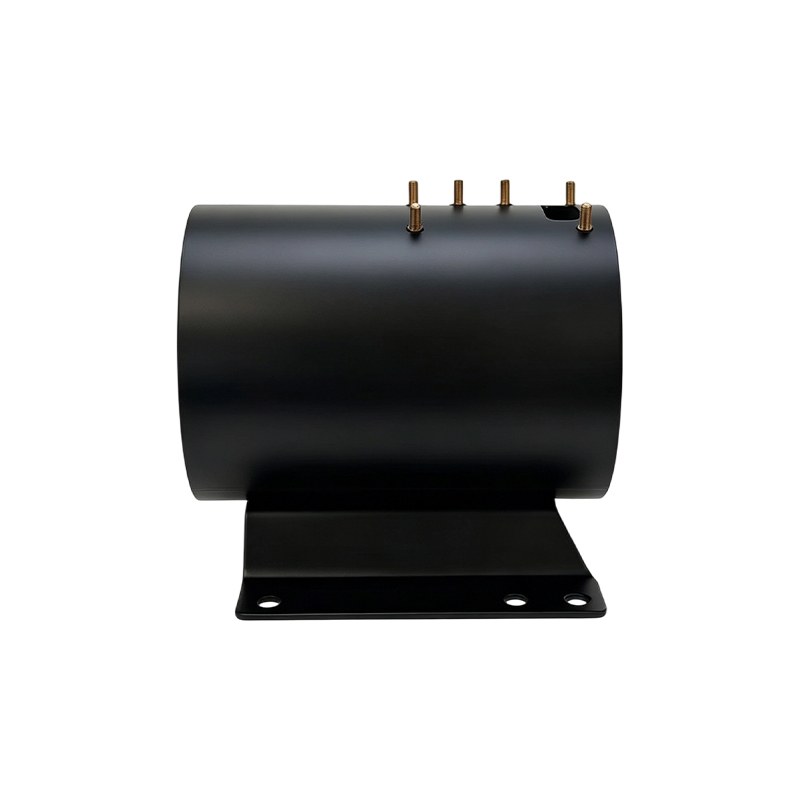
 Heavy-Wall Motor Housing with 343mm Bore and Mounting BaseThis extra-large housing combines a 6mm thick steel shell with a welded base, offering high rigidity and stable support. It suits extreme torque and vibration applications, addressing stiffness and mounting concerns raised in the surrounding discussion.View Product →
Material and Environmental Drivers of Motor Housing Failure
Corrosion failure follows geometry, not random metal loss. The first attack sites are the foot underside where paint is scratched, seal grooves where water pools, bolted joints with crevice corrosion, and cooling fin roots where salts deposit.
Material selection sets the timeline:
- Zinc-plated or painted carbon steel survives indoors; in coastal or washdown duty the coating fails within 12 to 18 months.
- Bolting an aluminum housing to a steel bracket in humid air creates a galvanic couple; the aluminum corrodes at the interface.
- Chlorides plus thermal cycling cause stress corrosion cracking in weld heat-affected zones; the cracks leak coolant through sound-looking walls.
- Lint, dust, or magnetite blocks cooling fins, raising housing temperature and accelerating seal failure.
Specify 304 stainless for washdown, coastal, food, and outdoor pump duty, and verify that O-ring grooves are machined, not cast.
Our stainless steel motor housing guide for corrosion-proof motor design covers the full material comparison. In corrosive service, the machined bore, seal seat, and mounting interface must be specified together.
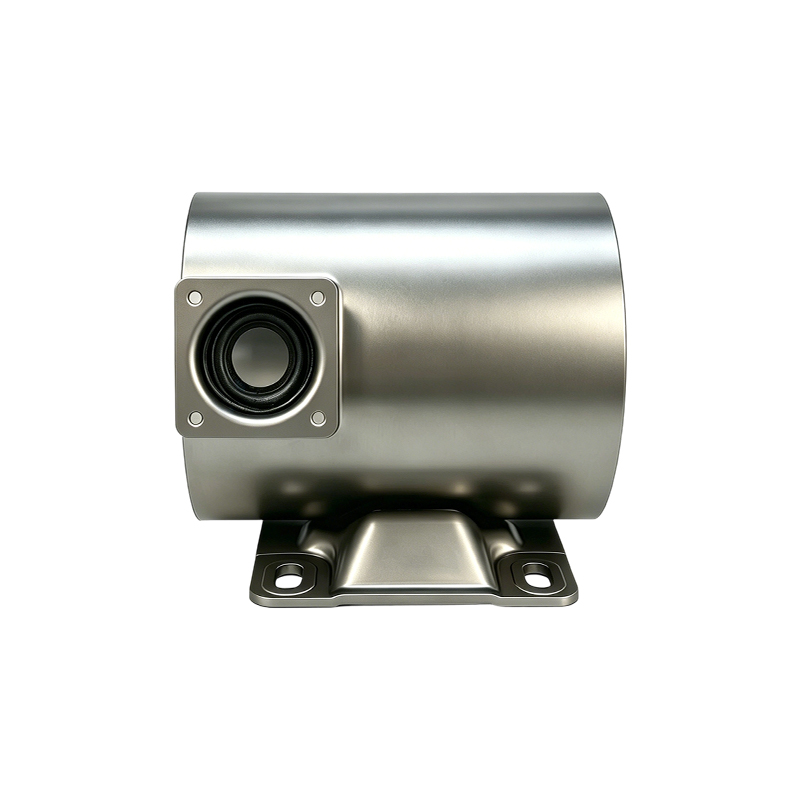
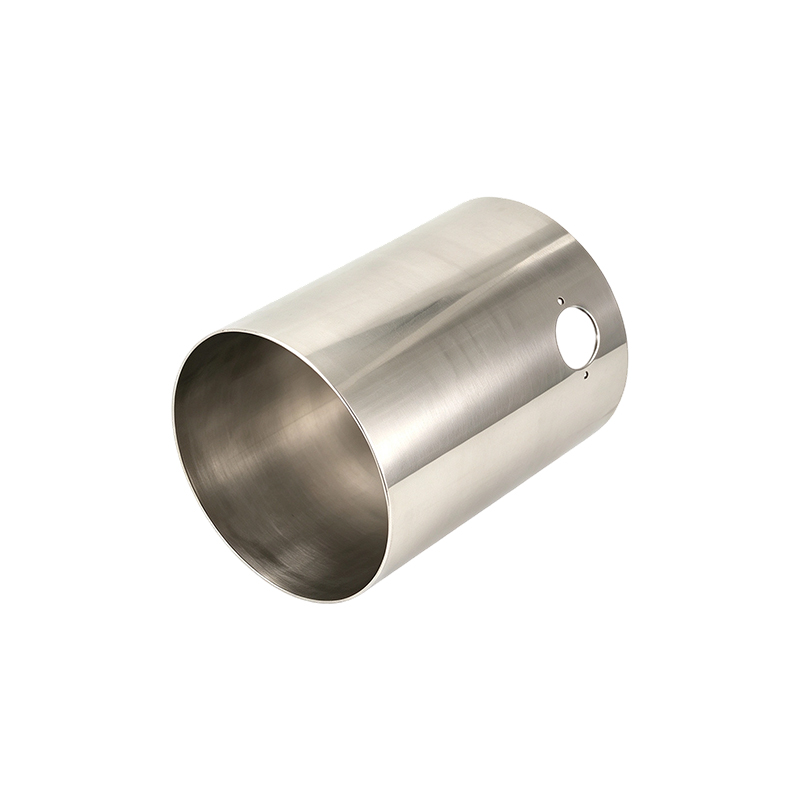 304 Stainless Steel Motor Housing with 139mm Inner DiameterCorrosion resistance is the key advantage of this stainless steel housing. When machining, sealing, and mounting must be specified together for corrosive service, this component provides a suitable material choice for long-term durability.View Product →
Design Mismatch or Manufacturing Defect: Who Owns the Problem?
A housing that cracks in every installation is a design problem; a housing that cracks in one batch out of ten is a process problem. Confusing the two leads to adding wall thickness to a component that was never out of tolerance.
Design mismatch
- Print dimensions met, application capacity exceeded
- Same failure repeats across different suppliers
- Resonance confirmed by frequency sweep
Manufacturing defect
- Dimensions or material deviate from print
- Failure hits one production batch only
- Porosity or cracks at the stamping radius
If the failure follows the application, fix the specification. If it follows the batch, fix the process.
Interface failures occur when the mounting frame deforms the housing, the bolt pattern cannot distribute dynamic load, or the foot geometry does not match the driven equipment. Foot-mounted motor housings are the most common geometry in these cases and have the best-documented failure maps.
For a redesign, a steel tube housing with the same bore and base coordinates raises stiffness without changing the external envelope.
 Heavy-Wall Motor Housing with 123.8mm Bore from Seamless TubeThis precision-machined housing uses a 9.6mm seamless steel tube for high torsional strength and excellent roundness. It is built for heavy-load, high-vibration motors, aligning with the need for stiffness without changing the external envelope.View Product →
How to Prevent Motor Housing Failure at the Specification Stage
Most housing failures are specified into existence before the first part is machined. A print that omits a duty point, a coating system, or an acceptance test transfers the risk to the manufacturer and the end user.
- Confirm wall thickness and grade against locked-rotor torque and shock load
- Require bore runout and roundness data on every lot
- Match the coating system to the operating environment
- Mandate a pressure decay test on liquid-cooled housings
- Define a natural frequency separation margin from running speed
- Specify filler, preheat, and stress relief for walls above 6 mm
Jiangsu Yufeng Electric Co., Ltd. keeps stamping, welding, machining, and surface treatment under one quality system, with annual capacity above five million housings and an engineering team that supports specification review before tooling is cut.
Frequently Asked Questions
What is the most common cause of motor housing failure?
Fatigue cracking from resonance, cyclic shaft loads, or shock events is the most common single cause, followed by corrosion-driven wall thinning. In field populations, cracking and corrosion together account for roughly half of all housing-related removals.
Can a cracked motor housing be repaired and returned to service?
A small crack away from the bearing journals in a carbon steel housing can be welded, but the heat-affected zone becomes a new crack site. If motor housing failure analysis shows the crack was stress related, replacement with a stiffer housing usually costs less than a repeat failure after repair.
How do you detect housing distortion before it damages the motor?
Measure bore roundness and bearing seat runout with the housing unclamped, then repeat with mounting bolts at full torque. A change of more than 0.05 mm indicates installation distortion that must be corrected before assembly.
When should a stainless steel motor housing be specified?
Specify 304 stainless for washdown, coastal, food-processing, and outdoor pump applications where painted carbon steel fails within 18 months. Stainless does not eliminate all failure modes, but it removes corrosion as the dominant root cause.
A housing that fails early was almost never a random event. The crack, the leak, or the distortion is a record of load, environment, and process history; motor housing failure analysis is the method for reading that record correctly.
 Previous